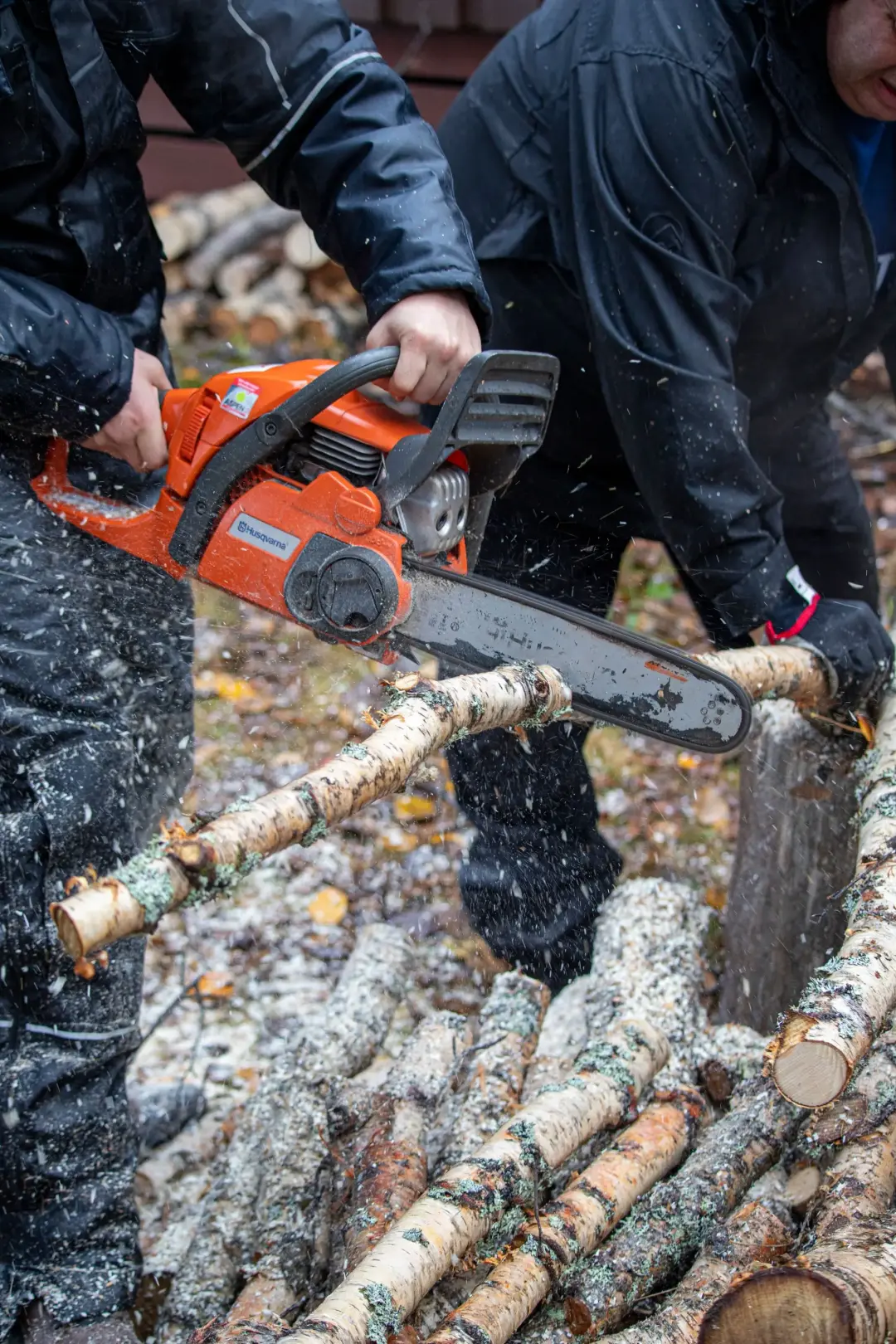
A chainsaw can cause life-threatening bleeding in seconds, often at a remote or difficult-to-reach site. A chainsaw operator’s first-aid kit must therefore address catastrophic bleeding and responder protection before everyday cuts.
There is no single statutory contents list for every UK workplace kit. The Health and Safety (First-Aid) Regulations 1981 require adequate, appropriate provision based on a first-aid needs assessment. HSE gives more specific guidance for tree work, and the site also needs a larger central kit.
What is legally needed in a first-aid kit?
Contents should reflect the hazards, workforce and location. For chainsaw work, assess severe cuts, falling timber, crushing, burns, eye contamination, crew size, mobile coverage, terrain, weather and ambulance access, plus trainees, the public and known medical needs.
For tree work, HSE says operators should carry a personal first-aid kit while at work. Current HSE tree-work guidance specifies at least one or more haemostatic dressings, a tourniquet, plastic gloves and a Resusciade or similar resuscitation barrier. HSE separately advises keeping a worksite kit in a central location. These are minimum sector-specific expectations, not a ceiling on provision.
A BS 8599-labelled kit can be a useful starting point, but the standard is not a legal requirement and a generic kit may not meet the chainsaw-work assessment. Check the contents, not just the label.
Personal kit versus the worksite kit
The personal kit is compact trauma provision carried by the operator, including a climber aloft. It should be weather-resistant, consistently arranged and reachable with either hand. Gloves, tourniquet, haemostatic product and trauma dressing must be accessible immediately.
The worksite kit supports more casualties and injury types. It needs duplicate bleeding modules, sterile dressings, eye and minor-wound supplies, burn covering, extra gloves, shears and foil blankets. Move it to a marked central point if the vehicle is distant or may leave.
One does not replace the other. The injured operator’s pouch could be inaccessible or damaged, so an aerial rescuer or ground first aider needs another bleeding-control module. Brief the team on the location of both levels before work starts.
Essential chainsaw first-aid kit contents
A practical personal module should normally contain:
- Several pairs of correctly sized disposable nitrile gloves
- A recognised commercial tourniquet covered by the user’s training
- Haemostatic gauze or a haemostatic dressing suitable for trained use
- A large trauma or pressure dressing
- A compact resuscitation face shield or barrier
- A method of recording tourniquet application time
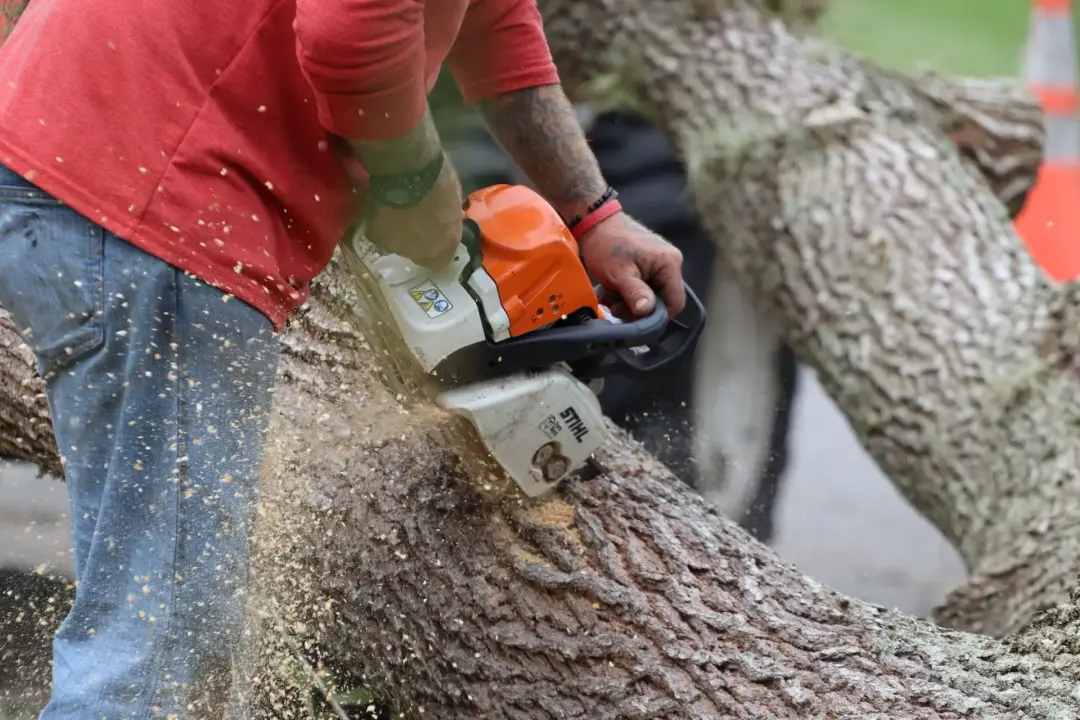
The central forestry kit should duplicate those items and add plain packing gauze, large and medium sterile dressings, eye pads and sufficient eyewash, plasters, triangular bandages, tape, guarded-tip shears, cleansing wipes, burn covering, foil blankets, waste bags and a casualty card. Increase quantities for larger teams or remote sites.
HSE recommends against routinely keeping medicines in a workplace first-aid box. Oxygen and advanced medical products require additional competence and governance.
Tourniquets for chainsaw users
Choose a traceable commercial tourniquet from a reputable supplier; counterfeit copies may fail. Keep a separate training model because repeated practice can wear an operational item.
Resuscitation Council UK’s 2025 guidance says to apply a tourniquet as soon as possible for life-threatening bleeding from a limb that direct pressure has not controlled. It should be placed approximately 5–7 cm above the wound, not over a joint, and tightened until the bleeding stops. Record the time, call 999 and monitor the casualty. If bleeding continues, trained responders may need a second tourniquet above the first.
Do not loosen or remove an applied tourniquet; that should be done by a healthcare professional. A tourniquet is for life-threatening extremity bleeding, not ordinary cuts and not wounds to the chest, abdomen or neck. Practical training is essential.
Trauma dressings and haemostatic gauze
A trauma dressing combines a large pad with a bandage that maintains pressure. Choose one sized for foreseeable saw wounds and practise securing that design. Small dressings are a poor substitute.
Haemostatic gauze supports clotting during sustained pressure and may help in a compressible wound that can be packed. Products specify different techniques and pressure times, so standardise the product and train with an inert version.
Wound packing is a hands-on skill. Gauze is placed firmly and progressively into an appropriate deep wound so that pressure reaches the bleeding source, then pressure is maintained and the pack secured. Do not pack wounds to the chest or abdomen or remove embedded objects. Follow current first-aid training and call 999 early.
Gloves, shears and supporting equipment
Nitrile gloves reduce contact with blood and avoid latex-sensitisation concerns. Carry several pairs because they tear, and place one at the top of every trauma module.
Guarded-tip trauma shears help expose a wound through chainsaw trousers and layered outdoor clothing without unnecessarily moving the limb. They must be robust, clean and secured safely. A foil blanket helps limit heat loss, but the casualty should never be wrapped so tightly that bleeding or breathing cannot be monitored.
A casualty card, permanent marker, head torch and charged communication device support treatment and handover. Record any tourniquet time.
Burns, eye injuries and minor wounds
For a thermal burn, stop the burning process and cool the injury with cool or lukewarm running water for 20 minutes. Do not use ice, creams or greasy substances. After cooling, cover loosely with cling film or a sterile non-fluffy covering and keep the rest of the casualty warm. Burn gel is not a substitute for adequate water cooling.
Carry enough sterile eyewash for meaningful irrigation, plus sterile eye pads. Do not rub the eye or remove an embedded object. Chemical exposure needs immediate prolonged irrigation and urgent help.
Plasters, medium dressings and cleansing wipes are useful for minor injuries, but keep them in a separate compartment so they do not obstruct the trauma equipment.
Accessibility during tree work
Attach a personal pouch only to a manufacturer-permitted harness point, clear of the bridge, buckles and device. Make it reachable with either hand and practise opening it low down while wearing gloves.
The central kit should be clearly marked and available without entering the drop zone, crossing running machinery or finding a vehicle key. For remote work, place it at the site control point. A grab module should be ready to travel with the aerial rescuer.
Accessibility is also procedural: everyone must know who calls 999, who retrieves the kit, who performs rescue and where responders will meet the ambulance.
Inspection, expiry dates and replacement
Before each job, confirm the pouch is present, dry and stocked with sealed trauma items. A named person should complete a documented inventory at an assessed interval; monthly is a practical starting point for active kits.
Check expiry dates, packaging seals, glove condition, tourniquet stitching and hardware, eyewash integrity and the cleanliness of reusable shears. Heat, fuel, moisture and sunlight may damage products before their printed expiry. Any opened sterile product counts as used and should be replaced.
Replenish immediately after an incident or drill, and inspect after water ingress, a fuel spill, impact or tampering. Operational tourniquets and sterile products must not be repeatedly used for demonstrations. Mark training stock clearly and store it separately.
A kit is only one part of the emergency plan
Chainsaw first-aid kit requirements cannot be separated from competence and rescue. The team needs suitable first-aid training, an exact location or grid reference, reliable communication, known emergency access and a practised response. Where climbing occurs, a second person must be available, trained and equipped to carry out aerial rescue.
supplies job-specific first-aid kits built around the work being done rather than a generic label. Match the contents to the first-aid needs assessment, then make sure every operator knows where the kit is and how to use the equipment within their training.
Need first-aid equipment suited to chainsaw and tree work? Contact for help choosing a practical kit matched to your risks and training.
Related Articles
What Climbing Kit Do You Need for Your First Course